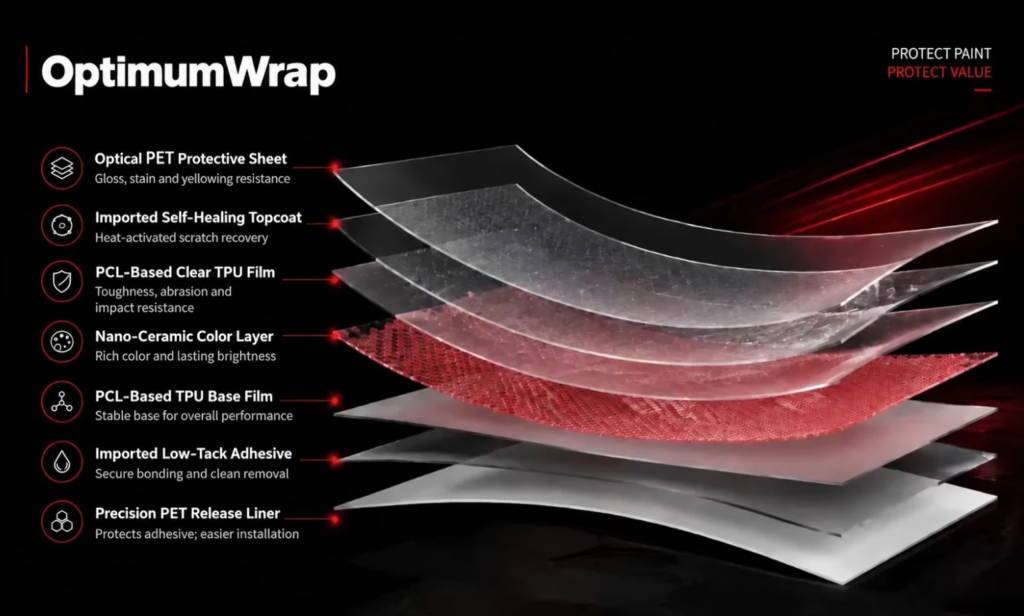
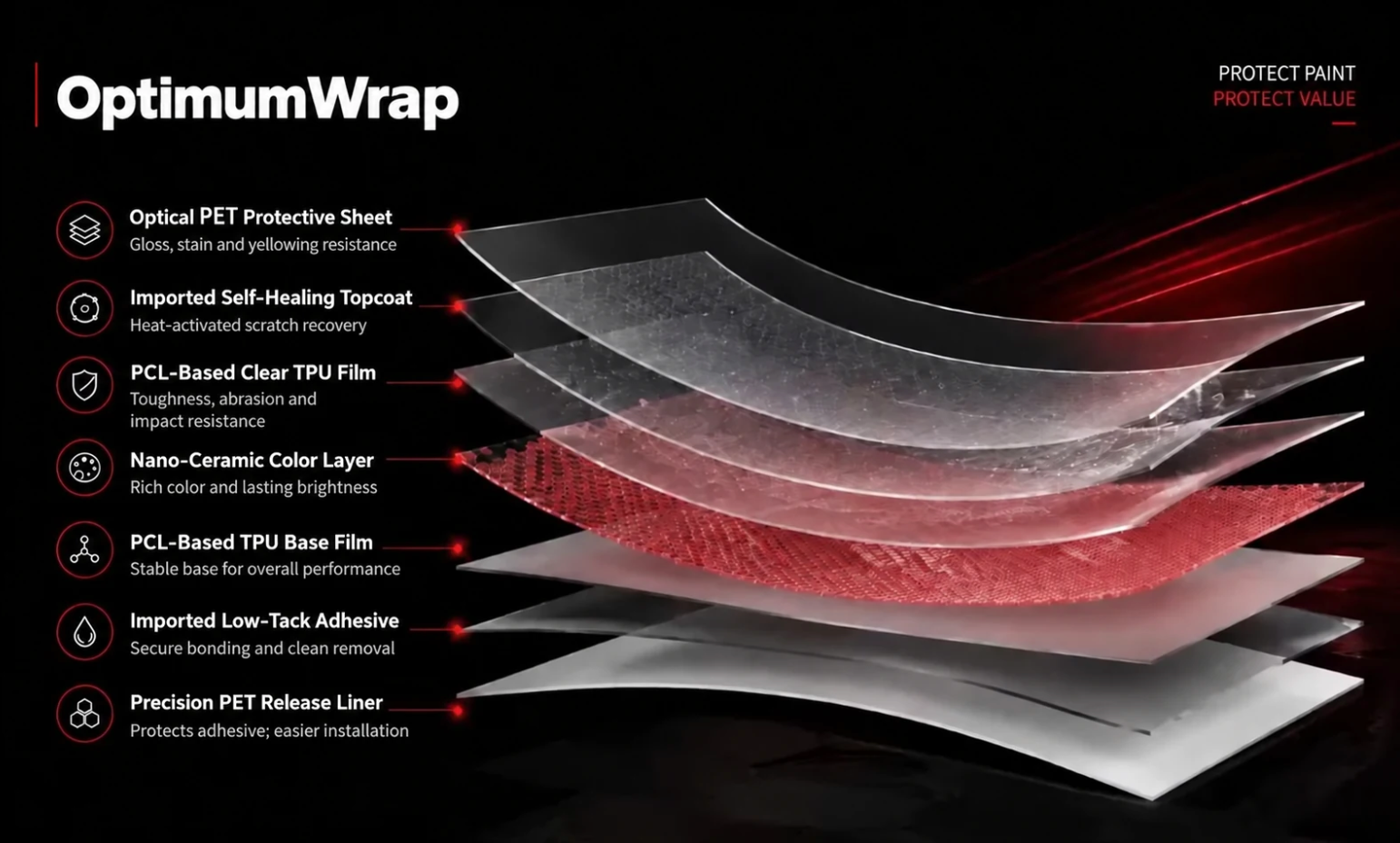
Explore the seven-layer structure of TPU color PPF, from PET liner and adhesive to the color layer, clear TPU, self-healing topcoat and protective sheet.
A TPU color-change film can look like a single colored sheet. Inside a layered construction, however, several materials work together to create its appearance, support installation and protect the surface beneath it. Understanding those materials explains much more than simply counting the layers.
This article follows a seven-layer design with a separate color layer, a transparent TPU layer and two removable PET sheets. It explains what each part does during production, installation and use. Other products may combine functions or use a different construction, so the diagram should be read as an example of this design rather than a universal specification.
 Seven-layer construction, shown from the outer protective sheet down to the release liner. The layer labels are shown in English and explained below. Open the image to view it at full size.
1. PET release liner: a production carrier and protection for the adhesive
The release liner is easy to overlook because the installer removes it before the adhesive meets the vehicle. Its role begins much earlier.
In the construction described here, the PET liner serves as the carrier on which the installation adhesive is coated. Its surface provides the interface for forming and handling that coating. Surface consistency and the release treatment therefore matter during production as well as when the liner is peeled away.
While the film is stored, transported and handled, the liner separates the adhesive from contact with surrounding surfaces. At installation, removing it exposes the adhesive for application. Keeping dust, fingerprints and other contamination away from that exposed surface remains part of the installer’s work.
The liner has two connected jobs: support the adhesive through production and keep it covered until use. It is a temporary component, not part of the protective thickness left on the car.
2. Installation adhesive: balancing attachment and eventual removal
The adhesive forms the interface between the film and the vehicle’s painted surface. A suitable system must support application, hold the film in service and allow removal under its stated conditions.
Two ideas help explain its behavior. Adhesion describes how the adhesive bonds to a surface. Cohesion describes the internal strength of the adhesive itself. The balance matters: an adhesive must attach to the intended surface while remaining sufficiently intact for the demands of use and removal.
The source material uses specialist pressure-sensitive adhesives, including Bostik as an example, to explain why adhesive selection matters. A supplier name alone does not establish the behavior of a finished film. The grade, formulation, coating process, aging conditions and substrate all need to be considered.
Edge lifting, difficult removal and adhesive residue are problems worth discussing with the supplier and installer, but they cannot all be diagnosed from the adhesive brand or a single layer diagram. A promise of clean removal also needs its paint-condition and service-life limits. Refinished, poorly bonded or aged paint requires particular attention to the applicable instructions.
3. TPU base film: mechanical support, a color foundation and coverage
TPU stands for thermoplastic polyurethane. Its segmented structure combines relatively hard and soft regions, allowing material formulators to balance strength and abrasion resistance with flexibility and elastic behavior.
The base film in this example is described as polycaprolactone-based TPU. Polycaprolactone-based and aliphatic describe different aspects of a polyurethane formulation; one label should not be treated as proof of the other. The actual resin grade and finished-film data determine what can be claimed about yellowing resistance, elasticity, heat resistance and durability.
Within this separate-color-layer design, the base has three useful roles:
- Support the film mechanically. It contributes to how the construction stretches, handles and responds to everyday abrasion or impact.
- Provide a background for the color. A light or opaque base can form the visual foundation beneath a separate color layer.
- Control show-through. The opacity of the construction affects how much of the underlying paint color is visible through it.
Visual coverage must not be confused with repairing paint. Concealing a color difference does not restore loose paint or remove a surface defect. The vehicle still needs to meet the selected film’s preparation and application requirements.
4. The separate color layer: where appearance meets manufacturing
In this construction, color is formed in its own layer between TPU components. The source describes it as a “nano color layer.” Its purpose is to establish the intended hue, opacity and visual effect while keeping that coloring stage distinct from the supporting film layers.
The manufacturing idea is straightforward: separating functions gives the producer a way to develop the color layer and the supporting TPU layers individually, then combine them into the finished film. Color consistency still depends on the complete formulation and manufacturing process.
Another route introduces a pigment or color concentrate into the TPU material before the film is formed. Pigment selection, loading and dispersion can affect both appearance and material properties. This is the concern behind comparing a separate color layer with a colored base film.
That comparison should remain specific. Adding pigment does not, by itself, prove that every colored TPU loses its protective performance or becomes dull. Nor does a separate color layer automatically guarantee better results. Lubrizol’s materials-development literature discusses integrating color into TPU as a possible design route. The meaningful comparison is between finished constructions, supported by their appearance and performance data.
5. Transparent TPU layer: covering the color and contributing to the finish
The transparent TPU layer sits above the separate color layer. It places a clear film between the color and the outer surface, much as a transparent covering can protect an underlying decorative layer while allowing it to remain visible.
Its optical clarity, surface uniformity and the quality of the interfaces between layers contribute to how the color looks through the finished construction. Haze, texture or unevenness anywhere in that optical path can affect the final impression of depth and smoothness.
This layer also forms part of the physical film body. Its contribution to abrasion or impact resistance depends on the complete construction, including material properties and thickness. A diagram cannot establish protection against every stone strike, door impact or wash-related scratch.
The transparent TPU film and the surface topcoat perform different roles. One is a film layer over the color; the other is the functional surface that faces everyday use.
6. Self-healing topcoat: surface recovery and appearance retention
The topcoat is where the film meets cleaning, light friction and the surrounding environment. Depending on its formulation, it may provide surface-scratch recovery, stain resistance and other surface properties.
Self-healing coatings use material behavior that allows certain light surface marks to become less visible or recover under specified conditions. Some systems respond to heat. This is the principle behind demonstrations in which a lightly marked surface changes after warming; it is not a universal instruction to pour hot water onto any film.
The depth and type of damage matter. Recovery of a fine surface mark is different from repairing a cut through the film, a puncture or missing material. Follow the actual product’s demonstration conditions, care guidance and limitations.
The source also connects the coating with UV management and long-term color retention. Those functions need evidence for the complete film system. An eight-to-ten-year color-retention claim, for example, should identify the product, exposure conditions and written warranty rather than follow automatically from the words “nano coating” or “self-healing.”
Read more about the distinction between surface recovery and other performance claims in our self-healing film guide.
7. PET protective sheet: a forming surface and temporary outer protection
The outer PET sheet completes this seven-layer example. In the manufacturing route described in the source, the topcoat is formed against a PET carrier and its release surface. That contact surface helps define the coating’s finish during formation, including the intended gloss or matte appearance.
This explains why the outer PET sheet is more than an incidental packaging layer in that process. It participates in production and also covers the finished surface during subsequent handling.
For installation, the supplier’s instructions determine when it is removed. Some procedures call for removing a cap sheet before particular cutting or application steps, so “always peel it after installation” should not be treated as a rule for every product. Removal reveals the working surface below; it does not create the film’s performance properties at that moment.
How the seven parts work together
This design separates several jobs across the construction: the liner supports and covers the adhesive; the adhesive bonds the film to the vehicle; the base provides support and a background; the color layer creates the appearance; the transparent TPU covers the color; and the topcoat supplies the exposed surface functions. The outer PET sheet assists production and temporary protection.
The central idea is coordinated manufacturing. Each component needs to perform its own role and work with the layers beside it. A defect in a coating or interface can matter even when every named layer is present.
Layer count therefore tells you how a particular design is described, not whether it is automatically better than every alternative. The two removable PET sheets also need to be distinguished from the layers that remain on the vehicle when comparing thickness. Our film-thickness guide explains how to check that measurement.
For a purchasing decision, bring the construction description together with a physical sample, the selected product’s technical information and its installation and warranty terms. That connects the attractive color you see with the material you are actually ordering.
Explore the OptimumWrap Color PPF collection or request a sample. Include the color or SKU and ask which construction and supporting documents apply to that exact film.
References
These references explain concepts and test methods; they do not establish equivalent test results for Optimum Wrap products. Confirm specifications for your selected product.